Interview of Dr. Max Kleinebrahm – WP9 Coordinator

Project ASIMUTE is a European multidisciplinary  research project that gathers women and men from various walks of life. Their experiences may be different but the people involved in the project are committed to the advancement of science. Let’s learn about their personal paths and motivations through a series of portraits.

In this seventh installment, WP9 leader Dr. Max Kleinebrahm, took some time off his busy schedule to answer our questions.

Question 1: What is your personal path? What led you to have a scientific career?

Dr. Kleinebrahm: I grew up in a small town in western Germany, between Bonn and Cologne, and later studied industrial engineering at RWTH Aachen University. During my studies, a course in thermodynamics taught by André Bardow sparked my interest in energy systems and the fundamental question of how energy can be supplied and used more efficiently. I therefore specialized in energy engineering. Exchange and research stays at NTNU in Trondheim, Norway, and the German University of Technology in Maskat, Oman, further shaped my path. They showed me how much I enjoy working in an international environment, teaching students and investigating complex questions in depth. What ultimately attracted me to science was the combination of detailed analysis and systems thinking. Researchers must understand individual technologies and human decisions, while always considering how they interact within the wider energy system.
 
Question 2: Did working in various international environments early in your career shape the way you look at a problem? If yes, how??
 
Dr. Kleinebrahm: Yes, definitely. Working in international environments taught me that people can approach similar problems from very different cultural, disciplinary and practical perspectives. This is what makes international and interdisciplinary collaboration so valuable. One important experience was my time in Oman, where I worked in the Department of Mathematics and helped organize the first IMAGINARY exhibition on the Arabian Peninsula. I learned that even small challenges can require significant effort if communication is unclear or assumptions remain implicit. This is especially relevant in energy research, where technical and economic analyses are important but often times do not capture all necessary constraints. Social constraints, everyday practices and acceptance issues strongly influence whether a solution is feasible.
 
Question 3: Why did you choose this area of research?
 
Dr. Kleinebrahm: Today, I lead the Energy Demand and Mobility research group at the Karlsruhe Institute of Technology. What I particularly appreciate about this field is the diversity of perspectives it brings together. My work ranges from teaching and supervising students to collaborating with doctoral researchers, developing research proposals and publishing scientific findings. This creates opportunities to contribute to both academic knowledge and practical decision-making. Energy economics is especially fascinating because the energy transition cannot be understood from a purely technical or economic perspective. It also involves human behavior, social acceptance, regulation and environmental impacts. Working with researchers from engineering, economics, computer science and the social sciences can be challenging because each discipline has its own methods, terminology and understanding of the problem. At the same time, this is precisely what makes interdisciplinary collaboration so rewarding. It challenges established assumptions, reveals aspects that one discipline alone might overlook and continuously broadens my own way of thinking.
 
Question 4: How is your area of research related to the project?
 
Dr. Kleinebrahm: Our Energy Demand and Mobility group studies how energy demand in households, transport and industry may change during the transition towards climate neutrality. We are especially interested in the interaction between individual consumers, local technologies and the wider energy system. This requires a socio-techno-economic perspective: we examine technical possibilities, economic incentives and human behavior together. ASIMUTE complements this work very well. The project connects household practices and expectations with technologies such as heat pumps, photovoltaic systems, electric vehicles and battery storage. In Work Package 9, we develop simulation and optimization methods for operating these technologies efficiently. Our objective is not simply to minimize energy consumption. We investigate how households and neighborhoods can reduce costs and emissions, support the electricity grid and integrate renewable energy while preserving residents’ comfort and respecting regional differences.
Question 5: What was the initial question you asked yourself at the beginning of the project?
 
Dr. Kleinebrahm: ASIMUTE gives us the valuable opportunity to conduct research across borders in France, Germany and Switzerland. One of my first questions was therefore how residential energy demand differs among these countries. Do households use energy differently? How important are differences in building age, insulation, heating technologies and everyday behavior? I was also interested in how decentralized technologies interact with national energy systems. France, for example, has traditionally relied strongly on nuclear power, while Germany has already phased out nuclear energy and is moving away from coal. These different systems can create different incentives for operating heat pumps, batteries or electric vehicles. We therefore examine the economic, environmental and comfort-related consequences of different operating strategies. However, the central question is not only where the countries differ. More importantly, we want to understand what they can learn from one another.
 
Question 6: Have you answered this question so far?
 
Dr. Kleinebrahm: We have made substantial progress, although the complete cross-border analysis will be concluded during the final project phase. We have developed simulation and optimization methods that show how residential buildings can shift electricity consumption over time. This flexibility can come from heat pumps, the thermal storage capacity of buildings, electric vehicles and batteries. Our methods consider several objectives simultaneously, including electricity costs, grid peak loads and residents’ thermal comfort. We have also developed machine-learning approaches that can reproduce sophisticated heat-pump control decisions much faster than repeatedly solving a complex optimization problem. This is important if such methods are to be applied to many buildings. Our next step is to transfer these approaches from selected case studies to representative building stocks in the participating countries. This will allow us to identify patterns and formulate conclusions that are transferable across regions.
 
Question 7: Have you already found “representative building blocks” in the Upper Rhine region? And, if so, can you tell us where they are situated and what made you pick them specifically?
 
Dr. Kleinebrahm: Yes, we have already identified representative buildings. In fact, even before ASIMUTE started, we worked on methods to identify typical residential buildings in Germany and across Europe. The aim was to better understand how technologies such as photovoltaic systems and batteries could spread in the residential sector, and under which conditions buildings might supply themselves with locally produced electricity. Our approach is based on clustering. In simple terms, this means that we group buildings with similar characteristics, such as building type, floor area, age and other relevant features. From these groups, we select a smaller number of representative buildings. We can then analyze these buildings in detail, for example by optimizing their energy system design or operation. The number of representative buildings we choose always depends on the complexity of the final analysis. Detailed energy-system calculations can be computationally demanding, so we need to find a balance between accuracy and feasibility. In our most recent study, for example, we were able to analyze more than 4,000 representative buildings across Europe. At this stage, however, it is important to clarify that we do not focus on individual buildings that can be named publicly. Instead, we work with representative building types for the Upper Rhine region. These are selected to reflect typical residential buildings in the respective countries.

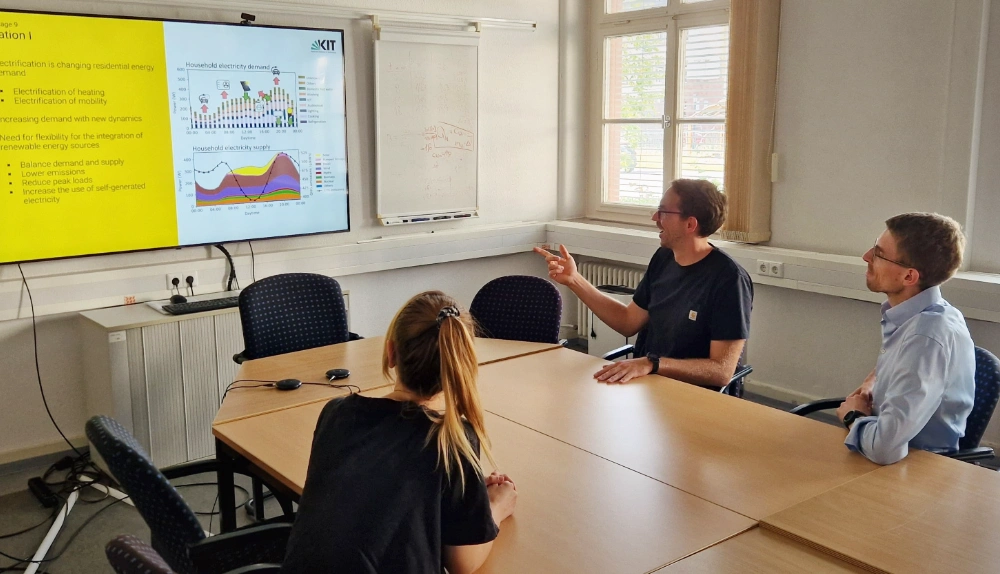
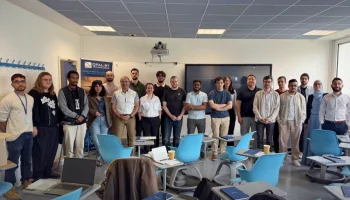
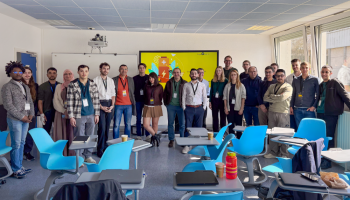
Prof. Kleinebrahm and the members of the Energy Demand and Mobility Group at Karlsruher Institut für Technologie

Question 8: Have you been confronted with residents’ reluctancy to share data? If so, what were the fears they formulated?
 
Dr. Kleinebrahm: In our own work, we are not directly collecting large amounts of primary data from residents. Collecting this kind of data can be very time-consuming and also raises important questions about privacy and data protection. We therefore mainly work with existing datasets and develop methods to combine many smaller datasets into larger, more useful ones. This allows us to derive findings that are more transferable across different households, regions and contexts. Data protection is a particularly important topic in Germany. This is also visible in the relatively slow rollout of smart meters, where questions of security, privacy and institutional implementation play an important role. At the same time, we believe that publicly accessible and well-documented data can be a central building block for supporting the energy transition. For this reason, we have been working on methods that can learn important relationships from sensitive data without making the sensitive information itself public. One promising approach is the use of synthetic data. In simple terms, this means creating artificial datasets that reproduce important patterns from real data, but do not reveal information about individual households. Such methods could make it easier to conduct meaningful research while still protecting residents’ privacy.
 
Question 9: What can you share with us about your current findings without revealing too much?
 
Dr. Kleinebrahm: One important finding is that residential flexibility can support the energy transition without requiring households to fundamentally change their daily lives. Heat pumps, for example, do not always have to operate at exactly the moment heat is needed. Buildings and hot-water tanks can temporarily store heat, allowing electricity consumption to be moved to periods when renewable power is abundant or prices are lower. Electric vehicles offer similar flexibility because they are generally parked for much longer than they need to charge. However, coordination is essential. If every household reacts to the same low electricity price at the same time, a new and potentially critical demand peak may be created. Our results therefore show the importance of balancing several objectives: reducing costs, avoiding excessive grid loads and maintaining comfort. Intelligent control methods can identify practical compromises between these goals and can do so increasingly efficiently.
 
Question 10: In case, as you state, “every household reacts to the same electricity price at the same time”, is there a residential compensation mechanism that would prevent or minimize the risk of a critical demand peak? If such a mechanism exists, can you explain it?
 
Dr. Kleinebrahm: Yes, such mechanisms exist. In Germany, §14a EnWG is an important example. Since 2024, new controllable household devices with a grid connection capacity above 4.2 kW, such as heat pumps, electric vehicle chargers or batteries, must allow grid-oriented control. If the local distribution grid is at risk of overload, the grid operator may temporarily reduce their power consumption, while a minimum power level remains available. Normal household electricity is not affected. In return, households receive reduced network charges. This is important because price signals alone can create new peaks if many households react simultaneously. §14a therefore adds a local grid perspective.
 
Question 11: When and why did you start working on environment-related projects?
 
Dr. Kleinebrahm: My interest in environmental research began during my university studies. I initially worked on life-cycle assessments of buildings and carbon-fibre-reinforced materials, examining environmental impacts across the complete lifetime of a product or structure. After specializing in energy systems, I designed an optimized energy-supply concept for a brewery. This project introduced me to operations research: mathematical methods for identifying effective decisions in complex systems. I became fascinated by the possibility of using these methods not only to improve individual energy-supply systems, but also to investigate much broader questions surrounding the energy transition. This interest eventually brought me to KIT-IIP for my doctorate. My research examined
  • how household behavior shapes energy demand (read the article),
  • whether residential buildings in Europe could supply themselves 100% self-sufficient with local renewable energy (read the article),
  • and how municipal energy systems can be transformed consistently with national climate targets (read the article).

Since then, understanding the interaction between individual decisions and system-wide transformation has remained central to my work.


...optimization should never focus exclusively on the lowest financial cost...

Question 12: Have you worked or are you working on other environment-related projects ? And, if so, would you mind telling us about their goals and/or results?
 
Dr. Kleinebrahm: As leader of the Energy Demand and Mobility group, I am fortunate to work on several projects connecting local flexibility with wider energy and mobility systems. Current projects include:
  • C2CBridge, which investigates an autonomous, battery-electric ride-pooling service linking rural communities with cities. We assess how this concept could reduce private-car use, emissions and pressure on local electricity grids.
  • BDL Next addresses bidirectional charging, which allows electric vehicles not only to consume electricity but also to return stored power to buildings or the grid when useful.
  • DEIMOS develops open models and datasets for understanding how European industry can decarbonize and provide flexibility.
  • A project I am particularly enthusiastic about is the Energy-Arena platform. The platform creates a continuously updated, public benchmark for energy forecasting, enabling researchers and practitioners to compare electricity-price, demand and renewable-generation forecasts under transparent, real-world conditions, thereby providing a basis for cumulative progress in the field of energy forecasting.

Together, these projects address different but closely connected elements of climate-neutral energy systems.

Question 13: Why is energy optimization important on a European scale?
 
Dr. Kleinebrahm: Energy systems do not stop at national borders. European countries exchange electricity, gas and other energy carriers, while sharing infrastructure, markets and climate objectives. Closer coordination can reduce the overall cost of the energy transition because countries have different renewable resources, demand patterns and storage opportunities. A more integrated system can use these differences to balance supply and demand. This has become particularly important amid geopolitical uncertainty and concerns about dependence on imported fossil fuels. Nevertheless, optimization should never focus exclusively on the lowest financial cost. It must also consider security of supply, greenhouse-gas emissions, public acceptance, regional resilience and the distribution of costs and benefits. The same principle applies at household level: the lowest cost solution is not necessarily the most comfortable, secure or socially acceptable one. European collaboration enables us to explore these trade-offs collectively and learn from different national experiences.
 
Question 14: Are you excited about other projects, be they yours or somebody else’s?
 
Dr. Kleinebrahm: I really like the KoRPSA project, which examines regional carbon-management strategies in the Upper Rhine region, including options for capturing unavoidable emissions and removing carbon dioxide from the atmosphere. What makes the project particularly valuable is its combination of technical and logistical analysis with research on public perception and acceptance. This interdisciplinary perspective is essential because carbon management will only contribute to climate neutrality if the available technologies are embedded in viable infrastructure and supported by society. RESUR addresses another highly relevant challenge: designing energy systems that remain robust during disruptive events such as geopolitical crises, supply interruptions or extreme weather.
Before taking over my current research group, I contributed to defining some of the disruptive scenarios now being analyzed. I am therefore very interested to see how my former colleagues represent these events in integrated models of electricity, gas and heat networks. Both projects show that future energy systems must be climate-neutral and efficient, but also resilient, socially acceptable and dependable under unexpected conditions.

Our latest news

Project ASIMUTE is a European multidisciplinary research project that gathers ...

On June 17 and 18, the Project ASIMUTE team participated ...

On June 4, 2026, the ASIMUTE team gladly welcomed Opal-RT, ...

ASIMUTE’s third-year workshop took place on Friday March 20 in ...