
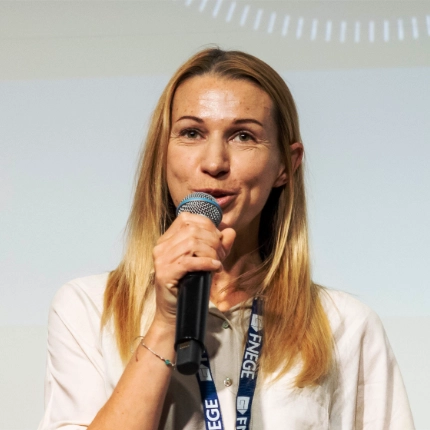
Interview of Prof. Virginie Schweitzer – WP4 Coordinator
Project ASIMUTE is a European multidisciplinary  research project that gathers women and men from various walks of life. Their experiences may be different but the people involved in the project are committed to the advancement of science. Let’s learn about their personal paths and motivations through a series of portraits.

In this fifth installment, WP4 coordinator Professor Virginie Schweitzer talks about her early career and shares her belief in the importance of users in the acceptance of smart meters.

Question 1: What is your personal path ? What led you to have a scientific career  ?
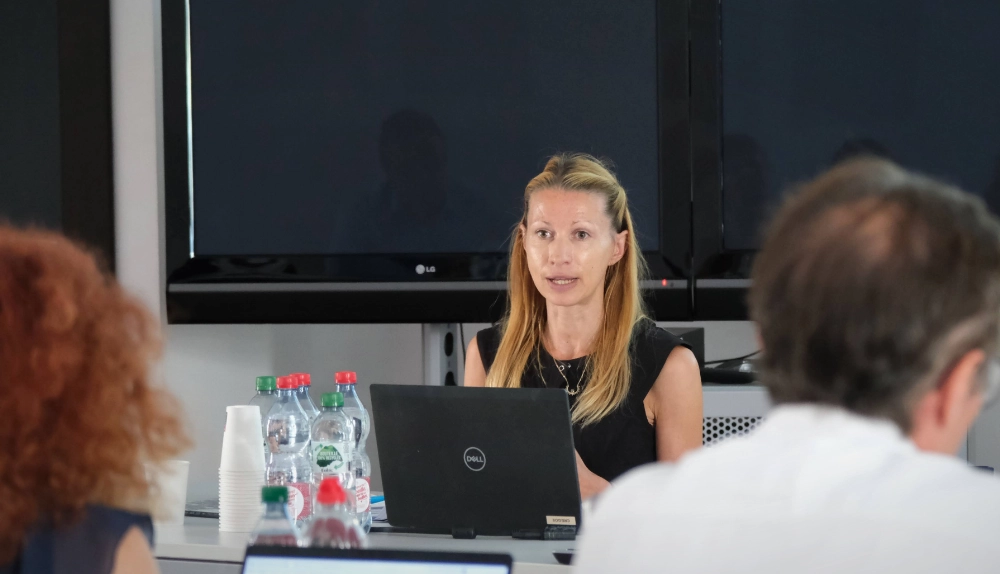
Prof. Schweitzer: After passing a Master degree in management, I worked as a Product Officer, Brand Officer and Marketing Manager for 9 years in a private company because, back then, I had not envisioned an academic career. Then, while thinking about my next professional step, I contacted a college professor to have a glimpse of academia, which I found really appealing. After a one-year college degree in marketing studies and research that confirmed my initial appeal, I started a PhD which got me involved in an Interreg research project, i.e. Smart Meter Inclusif. I completed my PhD in 2022 and have been a Management Science lecturer at Université de Haute-Alsace (UHA) ever since. What I like especially about my job is that it offers intellectual freedom and the opportunity to work on topics that bring together researchers from completely different fields.
 
Question 2: Why did you choose this area of research  ?
 
Prof. Schweitzer: Management sciences research that focuses on smart devices has been ablaze lately because, even though the devices have been developing fast, consumer adoption hasn’t followed the same path. These devices are sometimes confronted with resistance, especially when their use implies personal data sharing or when companies and macrostructures more or less make their use compulsory. I believed that numerous concerns surrounding the adoption of and satisfaction about these devices deserved to be documented. Moreover, these research areas had been covered lightly at UHA whereas they may trigger multidisciplinary research with other university departments.
 
Question 3: How is your area of research related to the project ?
 
Prof. Schweitzer: At the UHA CREGO lab, we developed a research axis focusing on consumers technology adoption. My PhD thesis actually dealt with the mechanisms of consumers’ psychological empowerment when they are faced with assisting technological devices (automatic cashiers, smart meters) in suggested self-production situations. As you may have noticed, I have been continuing my research on the adoption of incentivized devices, such as solar panels (governmental subsidies, social pressure…). A better understanding of the expectations and characteristics in relation to these devices, which increase consumer satisfaction, would ease in their deployment.
Question 4: What was the initial question you asked yourself at the beginning of the project ?
 
Prof. Schweitzer: In continuation of Smart Meter Inclusif, a previous Interreg project which I worked on in collaboration with Pr. Françoise Simon, I wanted to keep working on the mechanisms of incentivized-technology adoption. It is currently happening in Europe with solar panels, as European governments subsidize their deployment to make citizens engage in energy transition. I specifically asked myself if houselholds had different expectations about self-consumption devices when their freedom to choose to use them was impeded by incentivizing mechanisms and, sometimes, social pressure.

Then, aware that self-consumption devices are relatively new, we assessed that consumers likely harbored varying beliefs when it comes to the goals of using these devices. From this perspective, we thought it would be interesting to examine how households viewed the use of self-consumption devices and how they related their views to their own adoption of the devices.

After this initial thinking phase, many questions arose:

  • What are the households’ expectations of solar panels ? And how do these expectations contribute to their satisfaction in various deployment scenarios ?
  • How do they view the possibilities of these technologies’ continuous improvement ?
  • How do solar-panel-related beliefs (for instance, durability, cost savings,…) influence their adoption ?
  • At which degree is the adoption of solar panels motivated by technico-economic viability in comparison to belief-based characteristics ?
Question 5: Have you answered this question so far?
 
Prof. Schweitzer: We dealt with these questions one after another, in collaboration with a German research team from KIT (Karlsruhe Institute of Technology). The first question is done. I will present its results to you in the next paragraph. As for the other 3 questions, we gathered and are currently meticulously analyzing data from large French and German panels.

[WP4] results suggest the existence of psychological compensation mechanisms that aim at restoring satisfaction when consumers are incentivized to used solar energy...

Question 6: What can you share with us about your current findings without revealing too much?
 
Prof. Schweitzer: We have the first results about the impact of solar panels incentives on households’ satisfaction-reinforcing characteristics. They suggest the existence of psychological compensation mechanisms that aim at restoring satisfaction when consumers are incentivized to use solar energy. To be more precise, solar energy performances, energy safety and a device’s durability become essential to households when their freedom of choice erodes, as the lack of these characteristics turns into dissatisfaction. These results suggest solar panel companies should be mindful and communicate about these elements. They also invite politicians to consider the impact of incentives on household behavior. We submitted our results to an international marketing conference and an article on the subject is in writing.
 
Question 7: When and why did you start working on environment-related projects ?
 
Prof. Schweitzer: My interest in sustainable technology started during my PhD years, while working on Project Smart Meter Inclusif. I was instantly drawn to finding out how consumers interacted with these devices because, although their use and general acceptance slow down in some countries, they are confronted with resistance. Given the need for society to engage in energy transition, I wanted to understand the issues so as to better assist companies with the conception and communication around these devices. Since those days, understanding the underlying psychological mechanisms of these devices‘ adoption has been a major part of my research.
 
Question 8: Lately, have you been working on other environment-related projects ? And, if so, would you mind telling us about their goals and/or results ?
 
Prof. Schweitzer: In Interreg project Smart Meter Inclusif, my job aimed at modeling households‘ acceptance of smart meters. We demonstrated that consumer autonomy played a major role in the use of the device. We also pinpointed the sources of psychological disempowerment that are related to smart meters, in other words: households’ loss of control. We shed light on the risks of greenwashing on consumers when smart meters are implemented. To be precise, implementing these devices in households may deteriorate the psychological lever of energy transition acceptance if the implementation fragilizes an individual’s private data.

We came up with recommendations, for electricity providers, that can alleviate the fears of data-breach-concerned consumers:

  • Balance the consumer/provider relationship
  • Offer a simpler and more customer-centric data management.

Our results have been published in a Level-2 international management review (Technological Forecasting and Social Change, our article is available here) and we presented them in national and international conferences (for more info on this topic, please click on this link).

Question 9: Why is energy optimization important on a European scale ?
 
Prof. Schweitzer: As the European Union imports a large part of its energy, its optimisation is key to lowering its dependence on countries, especially politically unstable countries. To secure Europe energetically is necessary. By the way, by incorporating renewable energies such as solar and wind powers, the EU could drastically decrease its CO2 gas emissions and reach Europe’s climate pledge, which aims at carbon neutrality by 2050.
In Project ASIMUTE, we have been studying the role of consumers in European energy optimization. Does energy optimization play an important part in the decision process ? Are there additional factors that weigh in positively or negatively on energy transition ? What are the beliefs about energy consumption assisting technologies ?
 
Question 10: Do you think that, to harmonize energy consumption in Europe, we should survey consumers’ habits in each country ? And, if so, do you expect to find minor or major differences between the EU’s initial members and the most recent ones ?
 
Prof. Schweitzer: Yes, totally. It is important to understand consumers’ expectations about energy consumption control devices in each country. In Project ASIMUTE, we decided to systematically survey French and German households. We have already observed different expectations about solar panels that may be explained by stronger political and social pressures in Germany.
 
Question 11: Are you excited about other projects, be they yours or somebody else’s ?
 
Prof. Schweitzer: There are so many exciting projects I would love to work on or suggest as academic studies. But, as I have to pick : I have been following some recent Agence Nationale de la Recherche (ANR) projects such as ACSOBRIC, which delves into consumers’ acceptance of sobriety in a period of climate change, and LOBBIES, which questions the roles industries and lobbies play in the energy transition.

I am particularly keen on projects that study health and nutrition, as I used to work for food companies. Therefore, I have kept an eye on Project ALIMNUM because it proposes to analyze the link between the digital and nutritional habits of consumers.

To me, these projects are complementary to ASIMUTE because they aim at figuring out in what context consumers may change their behavior for a better environment and a better health.
Our latest news

Project ASIMUTE is a European multidisciplinary research project that gathers ...
Every year, sociology researchers and leading experts in commerce meet ...
On November 25, the ASIMUTE project hosted a conference named ...

We are pleased to announce that our partners from KIT, ...