
Interview of Bénédicte Laroze, LL.M. – Legal Research Assistant on WP6

Project ASIMUTE is a European multidisciplinary  research project that gathers women and men from various walks of life. Their experiences may be different but the people involved in the project are committed to the advancement of science. Let’s learn about their personal paths and motivations through a series of portraits.

In this sixth installment, WP6 legal and scientific collaborator Bénédicte Laroze shares with us how her personal beliefs have influenced her professional career and her research.

Question 1: What is your personal path? What led you to have a scientific career?

B. Laroze: My scientific research career was not obvious at first. I first passed a Bachelor degree then a Master degree in judicial law at Université de Bordeaux before starting a one-year French-German specialization. After this training, in opposition to the majority of law students who usually takes competitive examinations or start doctoral studies, I chose to step into the professional world. I then worked as a law advisor for a German company for five years… After several years of practice, I felt the need to give my professional life more meaning and to use my skills for a cause that is really dear to me: environmental preservation. Therefore, I took a remote German environmental law training. And, it is in this context that I came across a Scientific assistant position at Hochschule Kehl for an agrivoltaic project. I applied for then filled the position. That enabled me to start my scientific career while combining my personal beliefs and my legal skills.
 
Question 2: Why did you choose this area of research?
 
B. Laroze: Environmental preservation necessarily implies a greenhouse gas emissions decrease and therefore a complete transformation in the ways we produce and consume energy. Even though there are huge national disparities in greenhouse gas emissions in the energy sector because of different energy sources, energy transition is an undeniable ecological necessity. The possibilities that energy production centralization, consumption and production optimizations offer make them both social and economic necessities. On a judicial level, this transformation comes along with new energy regulations and policies. To observe and analyze how law has been evolving in such a dynamic environment is enthralling to me.
 
Question 3: How is your area of research related to the project?
 
B. Laroze: My job is directly funded by the projects I work on so my area of research is closely related to the projects’ themes. Nevertheless, I have had the chance to take part in various projects. Generally speaking, my area of research covers energy transition in a transnational setting, especially between France, Germany and Switzerland.
 
Question 4: What was the initial question you asked yourself at the beginning of the project?
 
B. Laroze: As a jurist, I first asked myself how the proposed energy models could be judicially translated. I quickly figured out that, though the European Union played a trailblazing role in energy transition, in the development of renewables and in energy communities, how these principles are transposed into national laws vary from one member-state to another. As for Switzerland, which isn’t part of the European Union, I wondered how much influence European energy laws could have on Swiss laws, especially when it comes to allow or facilitate commercial exchanges. Futhermore, on a consumer-centric level, I asked myself how laws could steer the optimization of energy production and consumption in order to make these new models more accessible.

...European [legal] harmonization is a prerequisite to the creation of solid transnational energy models...
Question 5: Have you answered this question so far?
 
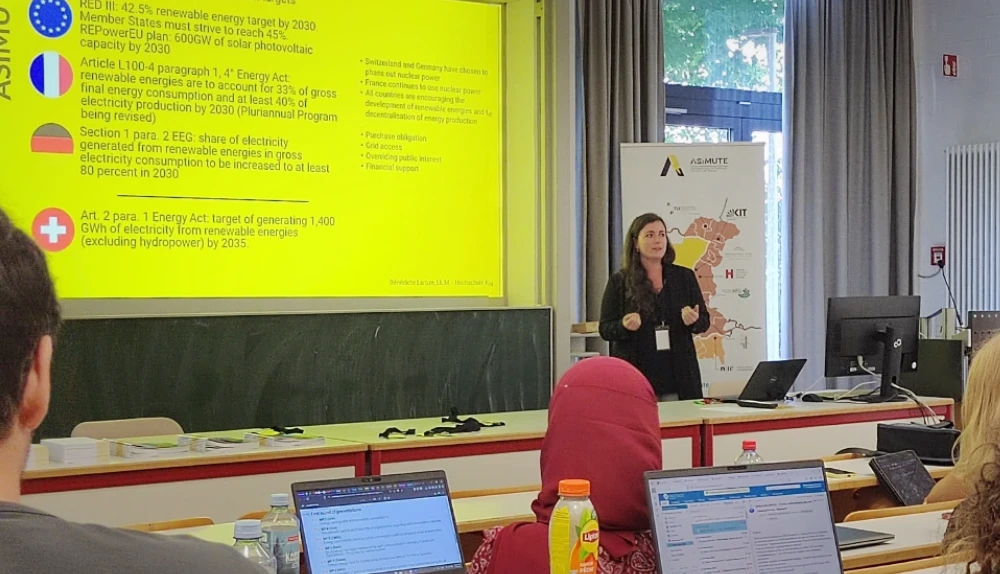
B. Laroze: The legal frameworks that can be applied to the decentralization of energy production and storage, and to individual and collective selfconsumption, are slightly different from one country to another. Whereas the European legislation aims at reaching harmonization, this does not include Switzerland, as it isn’t an EU member. By the way, national energy regulations, such as opting for nuclear energy, heavily influence legislative frameworks and the deployment of new energy models. These differences substantially explain the diverse observed approaches.
 
Question 6: What can you share with us about your current findings without revealing too much?
 
B. Laroze: My research mainly consists in a comparative analysis of the applicable legal systems in the three countries under study: France, Germany and Switzerland. From this basis, I propose potential solutions. In Germany, a parliamentary process about « energy sharing » (which is equivalent to collective selfconsumption in French law) is under way. Its outcome will weigh on our conclusions about the possibilities of the three legal systems’ harmonization. Today, there is no shared definition of collective selfconsumption, and the judicial conditions that can be applied to energy communities vary from one country to another. Even if those differences are not an impediment on a national level, European harmonization is a prerequisite to the creation of solid transnational energy models.
 
Question 7: When and why did you start working on environment-related projects?
 
B. Laroze: I started working on environmental projects after joining Kehl University, in July 2022. This choice was a very personal one as I wanted to contribute to ecological transition concretely.
Question 8: Your personal beliefs seem to feed your engagement. Can you tell us what events awoke your ecological sensibility?
 
B. Laroze: I’d rather say a series of events. The effects of global warming are undeniable, their scale has kept on increasing and the scientific evidence are unanimous. Although there are numerous solutions in various fields, applying them has somewhat been delayed. Sometimes, the hurdles are not technological but legal. Working in the field of energy transition makes me feel like I am useful to the cause.
 
Question 9: As you have been working on environment-related projects, would you mind telling us about their goals and/or results?
 
B. Laroze: The projects I have been involved in have one clear common goal: to contribute to energy transition. Some of them dealt with the development of new technologies, such as agrivoltaic or hydrogen projects, while some others aimed at making the decentralization of energy production and storage easier. For instance, on Project Modellregion Agri-PV Baden-Württemberg, we wanted to study the legal and administrative hurdles that blocked the use of solar-powered shading panels on agricultural plots. On Project CO2InnO, we researched the legal and administrative aspects, in both France and Germany, of using hydrogen as a heat source, and we also dived into additional aspects of energy transition such as the development of electric vehicles charging infrastructures, cybersecurity, sectoral coupling.In each of these projects, acting on a community level turned out to be essential. Locally-developed solutions are accepted more easily by a community, as its members can directly benefit from it. The decentralization of energy production, consumption and storage can thus contribute to increase energy justice and social justice. Not only is it an environmental necessity, it is also a concrete step toward social justice
 
Question 10: As you emphasize, energy transition will happen only if citizens are involved. Does any of your past projects clearly illustrate the relation between energy transition and social justice?
 
B. Laroze: Energy transition requires much more than just technological change. It is the number-one policy to reduce greenhouse gases and thus limit global warming. The impacts of the latter are particularly serious in developing countries, where strong weather phenomena have been more and more extreme and frequent, hurting an already vulnerable local population.
 
In the geographic zone that encompasses the projects I have worked on, i.e. Germany, Switzerland and France, if you look at the local levels, the increasing frequency of heatwaves has been an observable consequence of global warming. These waves particularly impact socio-economically vulnerable people: the homeless, low-income households that cannot afford energy renovation, renters who have no choice but to live in energy-wasting apartments. In this context, buildings renovation policies are of the utmost importance, because they aim at bridging the inequality gap when it comes to living and sanitary conditions.
 

However, improving buildings energy efficiency is far from enough. Energy transition also implies a complete reset of our energy production. Whereas solar power enjoys a large positive consensus, we cannot say the same for wind power, as it may trigger local protests. This is why initiatives such as citizen-driven energy communities, which the European Union supports, are particularly interesting: they enable citizens to invest in renewable energy providing installation and to benefit from both the output energy and its financial outcomes. Beyond the improvement of a project’s social acceptance, these initiatives bring better and fairer value-sharing.

Project ASIMUTE illustrates the link between energy transition and social justice pretty well. It aims at optimizing electricity consumption and production while promoting « prosumers » – citizens who both produce and consume energy – instead of relying on historical energy providers only. This model reinforces local energy autonomy and helps its inhabitants become meaningful actors of the ecological transition.

Here is another relevant example that clearly explains the link between energy transition and social justice: Project Modellregion Agri-PV Baden-Württemberg, which studies the relevance and feasibility of solar-powered agricultural installations. By placing farm owners at the heart of energy production, this project opens the gates to potential venues of income diversification. When you look at the recent agricultural protests and the precarious situations some of these owners have been living in, which sometimes climate change worsens, you understand that this project may be a way to bolster economic resilience and to offer a fairer share of transition-related benefits. Nevertheless, to avoid any unintended swerves, this technology has to be properly managed so that both farm owners and local actors, not large investing outsiders, benefit from it.

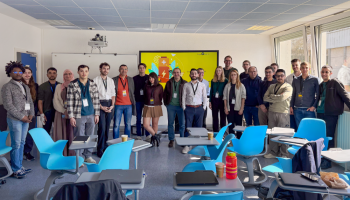
The ASIMUTE project partners, gathered in Kehl for the mid-project conference.

Question 11: Why is energy optimization important on a European scale?
 
B. Laroze: Rich and industrialised nations, among which we find European member-states, are characterized by high energy consumption levels. And, the energy sector emits high levels of housewarming gases when it relies on fossil fuels. Nuclear energy, though a low-CO2 emitter, brings along questions about security, waste management and climate change adaptability, especially in case of drought. Renewables are a solution to these issues but their intermittent characteristic bring supply safety challenges and grid management challenges. Therefore, we have to find a way to store energy surplus in order to use it in shortage scenarios. Energy optimization thus seems to be an essential condition for energy transition.
However, the necessary infrastructures are expensive and European member-states do not enjoy the same natural ressources (it is sunnier in the south, windier in the north). A European coordinated approach must be planned. Moreover, energy has always been at the heart of European history: to act as one single group is also a way to strengthen cooperation and maintain peace.
 
Question 12: Are you excited about other projects, be they yours or somebody else’s?
 

B. Laroze: Generally speaking, I am interested in all the research projects developed by KIAF (Kehler Institut für Angewandte Forschung), which I work for. These projects, which are varied and energy-transition related, feed my scientific curiosity and my professional involvement everyday. Beside CO2Inno and SynAgri-PV, which I mentioned earlier, KIAF has participated in numerous relevant energy transition projects. There is a long list but let’s put the light on the following 2:
  • Beschleunigung des Ausbaus der Floating Photovoltaik, which studies the development of floating solar-panel ensemble.
  • LOTUS (Locally Organized Transition of Urban Sustainable Spaces), which aims at developing innovative teaching tools to help transition toward carbon-neutral energy supply in an urban setting.

Our latest news

Project ASIMUTE is a European multidisciplinary research project that gathers ...
Project ASIMUTE is a European multidisciplinary research project that gathers ...

Every year, sociology researchers and leading experts in commerce meet ...

On November 25, the ASIMUTE project hosted a conference named ...